On Sunday morning, October 4, walkers came through open gates at the western end of the Foster Island trail and kept going until a fence stopped them. A Washington Trails Association trip report from that day says the trail was "fenced and locked at the east end." The western gates stood "completely open," and "many folks were out using the trail only to find they were blocked to continue into the arboretum causing a fair bit of confusion."
That fence belongs to one of two rebuilds underway this year at the Montlake end of the Washington Park Arboretum. The other is at the Seattle Japanese Garden, where a stone wall built in a hurry in 1960 has been replaced. Both projects fix compromises made when the original structures went in, and both are meant to open these places to more people for more months of the year. The garden's part is finished enough to see now, but only until the season ends on Sunday, November 29.
The Wall Iida Wanted in 1960
The Seattle Japanese Garden opened in June 1960. Tokyo Metro Parks supplied the design and sent Juki Iida and Nobumasa Kitamura to supervise construction. That spring, Iida and his stonework contractor, Richard "Dick" Yamasaki, ran short on time and money at the north end. According to the Arboretum Foundation's account of this year's groundbreaking, they built the north wall from less durable basalt so the garden could open to the public by June 1. The rest of the garden used granite.
Yamasaki looked after the garden for more than three decades afterward. The Foundation writes that he "continually expressed his wish for his mentor, Mr. Iida's vision of a proper stone wall" to be built someday, with a viewing pavilion on top. The basalt has since deteriorated. That deterioration is why the garden took on what it calls the Ishigaki Wall & Accessible Pathway project, a $2.8 million effort to replace the wall and add an accessible looped walkway at the north end of the central pond.
Fundraising began in 2022. In December 2025 the project was still almost $1 million short. Grants from The Norcliffe Foundation and Aldarra Foundation narrowed the gap. Donors Peggy and Steve Garber then pledged a $200,000 challenge gift on the condition that construction started by summer 2026. More than 30 individual donors gave within three months. In May, The Atsuhiko and Ina Goodwin Tateuchi Foundation made the gift that unlocked the Garbers' match. The $2.7 million campaign was celebrated at a groundbreaking on June 15, 2026, with 30 guests.
Built Without Mortar, Stone by Stone
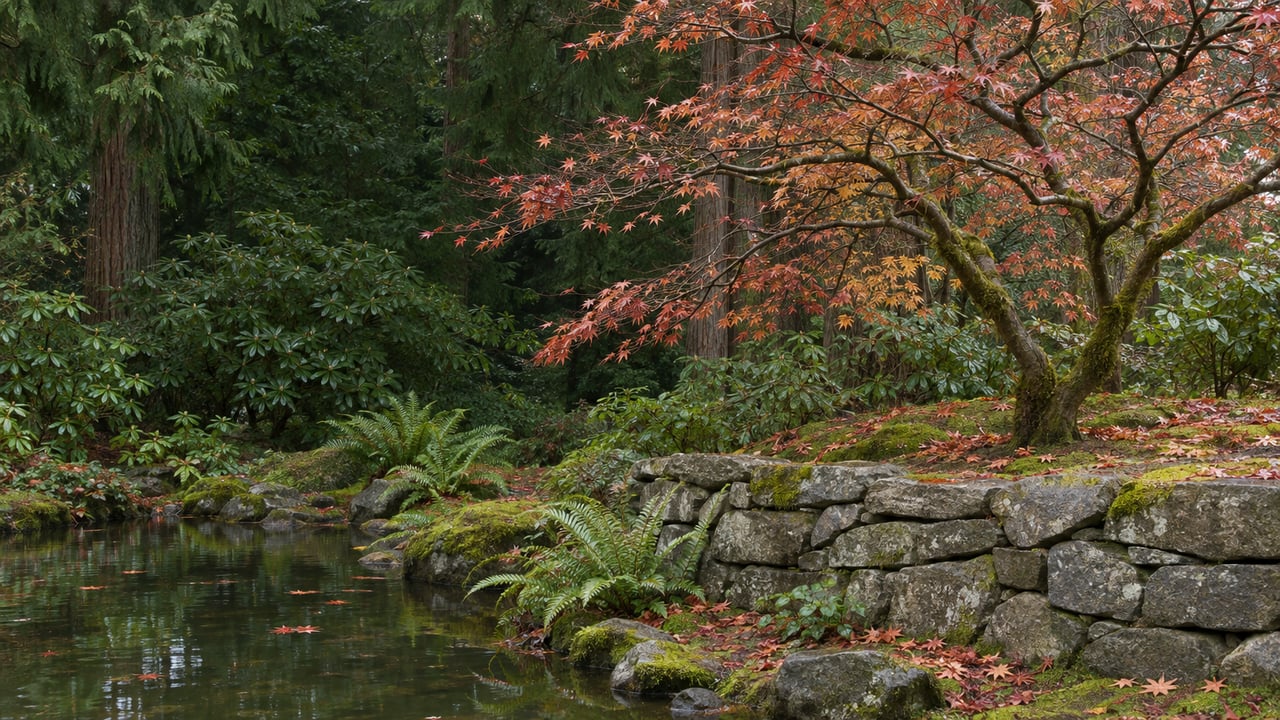
The new wall is an ishigaki, a traditional Japanese dry-stone wall laid without mortar. It was built by Suminori Awata, a 15th-generation stonemason in the Anoshu tradition. Walls in this style have long held up castle foundations, temples and gardens because they hold up well in earthquakes. On the Seattle Japanese Garden's blog, Awata describes his practice as "listening to the stones and putting them where they want to go." Before Seattle, he had worked with American stonemasons at Kubota Garden and Portland Japanese Garden.
Awata's U.S. partner was Green Man Builders. The wall was finished on September 10. Awata and most of the crew left on Monday, September 14. Project lead Kyle Schlagenhauf stayed with the rest of the crew to build the new accessible pathway along the north end of the pond. The Daily Journal of Commerce reported the wall's completion on October 28, and the North American Post ran a detailed profile of Awata and his craft on September 29.
According to the garden, the regraded walkways will let wheelchair users and families with strollers reach the shoreline area at the north end for the first time. The garden draws 100,000 visitors a year. The pavilion Yamasaki hoped for appears in the project renderings as a future addition, and Seattle Parks has put its design phase on hold.
The Garden Between Now and November 29
The garden shut completely from June 22 to July 27 and reopened July 28. Since then it has been about 80% open, with the north end closed off for construction. The garden also explains why the work happened in summer rather than during the winter closure: this kind of construction is only possible in summer.
| Detail | As posted by the garden |
|---|---|
| Address | 1075 Lake Washington Blvd E |
| November hours | Tuesday through Sunday, 10 a.m. to 4 p.m.; closed Mondays |
| Final entry | 45 minutes before closing |
| Season ends | Sunday, November 29 |
| Winter | Closed December through February for maintenance |
| Adult admission | $10; ages 6–17, seniors 65+, students and military $6; children 0–5 free |
| Koi feeding | Unavailable in 2026, resuming spring 2027 |
| Parking | Free but limited, often busy on weekends |
The garden says the southern part is quieter while the work continues, and it warns that construction noise may affect a visit. For photographers, the garden recommends weekday mornings as the least crowded time. When the gates close on November 29, the next chance to see the wall is the spring season. The garden's posted schedule shows March hours of 10 a.m. to 5 p.m.
The Same Kind of Repair on Foster Island
The fenced trail from the October report is the Arboretum Waterfront Trail. It also traces back to a compromise from the early 1960s. UW Botanic Gardens says the original Evergreen Point Floating Bridge cut Foster Island in half, and the trail was built after the bridge. The trail's overwater walkways sit low, and they regularly go underwater. The U.S. Army Corps of Engineers controls Lake Washington's level, keeping it lower in winter and raising it in spring. As a result, Seattle Parks says, the trail "may be impassable or difficult to navigate" in spring and summer.
Phase 1 is meant to fix that. In a May 19 Parkways announcement, Seattle Parks said contractor Redside Construction would install new overwater support piles, floats, walers, gangways and railings on the Foster Island section of the floating walkway "to improve trail accessibility and year-round use." Parks expects Phase 1 to reopen in early 2027. The total project budget is $2.45 million, which includes mitigation funds from the SR 520 bridge reconstruction. The Arboretum Foundation reports that the Seattle Park District has provided $1.1 million to design Phase 2, which covers Marsh Island.
The closure falls during the low-water months, when the old walkway is usually easiest to walk. Parks has said it plans to rebuild the trail in phases as funding allows. The Foster Island segment is the first section designed to stay usable when the lake rises again.
Where the Arboretum Calendar Goes in December
With the garden closed and Foster Island fenced, December activity near Montlake moves to the Graham Visitors Center and the neighborhood's own streets:
- Gifts & Greens Galore, the Arboretum Foundation's winter market, runs December 5 and 6 from 10 a.m. to 4 p.m. at the Graham Visitors Center, with free admission and parking.
- Montlake Community Club Winter Caroling is December 12 from 2:30 to 4:30 p.m. Neighbors can host carolers or join the walk, and the club asks for sign-ups by November 29, the same day the Japanese Garden closes for the season.
- The Winter Solstice Luminaria Walk is a ticketed, one-mile walk lit by luminarias, starting from the Graham Visitors Center on December 18 and 19, with entry at 6 p.m. or 7:30 p.m.
Up on 24th Avenue East, the former Fuel Coffee space at 2300 24th Ave. E. is becoming Taru Coffee & Play. Capitol Hill Seattle Blog reported that neighborhood resident Filisha Shah wanted a rainy-day spot where adults could get coffee while children play. Her plans include a toddler play area called The Grove, Stamp Act coffee, pastries and a larger food menu.
The Japanese Garden's last day of 2026 is Sunday, November 29. Final entry is at 3:15 p.m., and the garden reopens in the spring with its granite wall in place.
Projects like a new stone wall and a rebuilt waterfront trail shape what living near the Arboretum is like, and they are part of how Brad Hinckley understands Montlake from street to street. If you want to know how the neighborhood's parks and amenities show up in your home's value, request an instant home valuation or schedule a market strategy consultation.